
Intro to landing pages that convert
A landing page is a focused, single-goal page built to convert a specific audience into a specific action, and that singular focus is exactly what separates it from a normal website page. Where a homepage serves many visitors and many purposes, a landing page serves one campaign, one message, and one decision. That focus is its superpower, and it’s why a well-built landing page often converts several times better than sending the same traffic to a general page.
This guide breaks down what makes a landing page convert, how it differs from a standard page, and the elements that turn arriving clicks into customers.
What a landing page is for
A landing page exists to receive traffic from a specific source, an ad, an email, a campaign, and convert it toward one goal. Because you know where the visitor came from and what they’re looking for, you can tailor the page precisely to that intent, with nothing competing for their attention.
That’s the core principle: one page, one audience, one action. Everything on the page either moves the visitor toward that action or it shouldn’t be there.
How a landing page differs from a normal web page
The difference is focus and freedom:
- A homepage serves everyone and many goals; it has navigation, multiple paths, and broad messaging. It’s a hub.
- A landing page serves one segment and one goal; it often removes navigation and alternative paths so the visitor stays on the single track toward conversion.
Sending paid or campaign traffic to a homepage instead of a dedicated landing page is one of the most common and expensive mistakes in digital marketing. The homepage’s many options dilute the focused intent the visitor arrived with. A landing page keeps that intent intact.
The anatomy of a high-converting landing page
1. A headline that matches the visitor’s intent
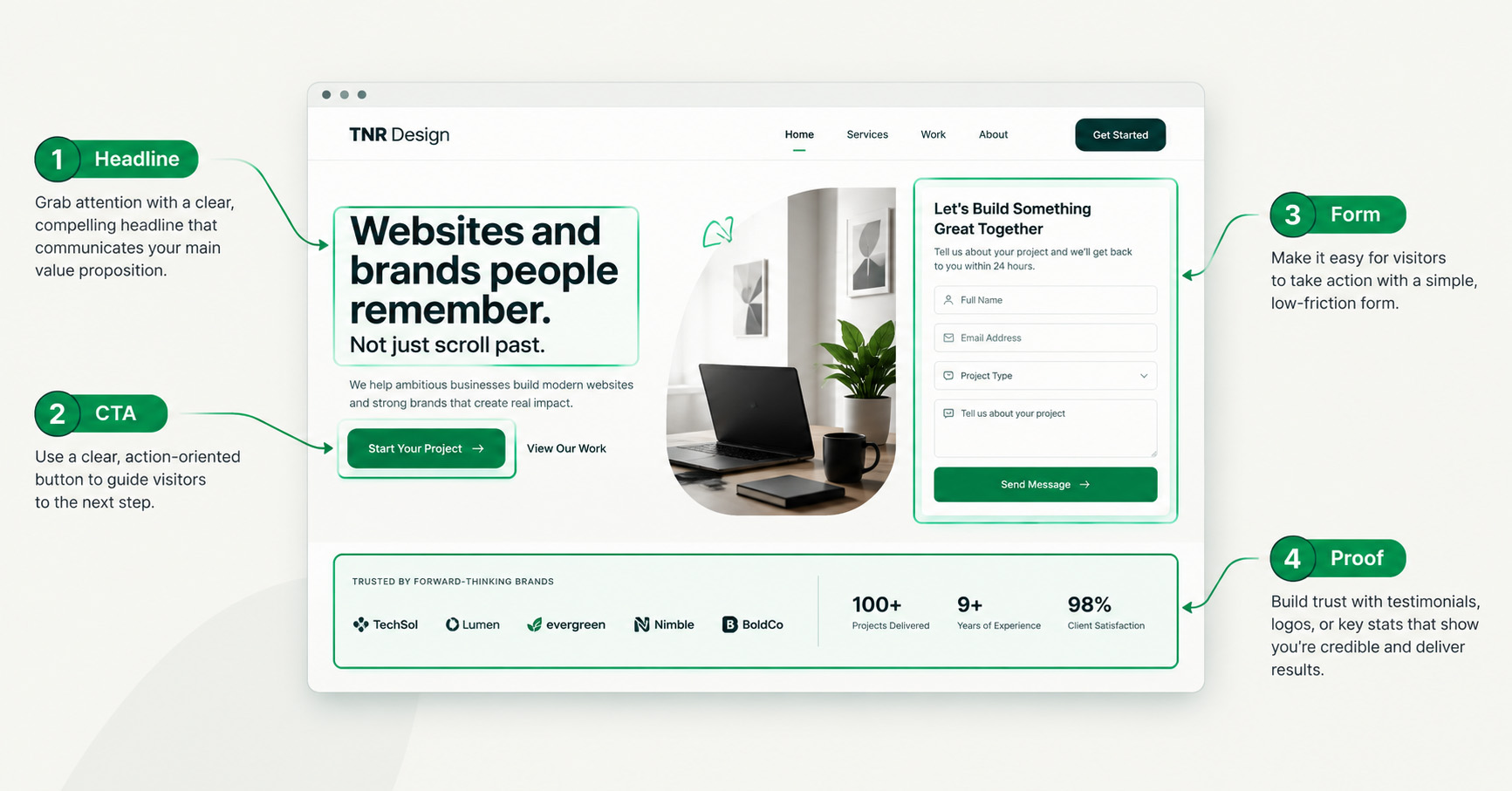
The headline must connect directly to whatever the visitor clicked. If your ad promised a free audit, the headline should be about the free audit. This “message match” reassures the visitor they’re in the right place; a mismatch causes immediate drop-off. The headline is the make-or-break element.
2. A clear, singular call to action
One primary action, stated specifically, repeated as needed. Not “submit” but “Get my free audit.” A landing page with multiple competing CTAs is a landing page fighting itself. Decide the one action and commit to it.
3. Benefit-led, scannable copy
Lead with what the visitor gets, not a list of features. Keep it scannable: short sections, clear subheads, because people decide fast. Every line should answer “why should I care?” and move toward the action.
4. Proof and trust signals
Testimonials, results, recognisable logos, guarantees, and reviews reduce the risk of acting. On a landing page, where you’re often asking a stranger to act immediately, proof does heavy lifting. This connects to building trust online; trust is what converts hesitation into action.
5. A focused, friction-free form
If you’re collecting information, ask for as little as possible. Every extra field reduces completion. Match the form length to the commitment: a newsletter signup needs an email; a high-value enquiry can justify a few more fields. When in doubt, cut a field.
6. Fast load and mobile-first design
Landing pages often receive paid traffic, which makes every lost visitor literally costly. Slow load wastes ad spend. The page must load fast (the Core Web Vitals point applies directly) and work flawlessly on mobile, where much campaign traffic arrives.
7. Minimal distractions
Remove anything that pulls focus from the action: unnecessary navigation, unrelated links, competing offers. The discipline of subtraction is what gives landing pages their edge.
Common landing page mistakes
- Sending traffic to the homepage instead of a dedicated page, diluting intent.
- A headline that doesn’t match the ad or email, breaking message match and trust.
- Too many calls to action, splitting attention and lowering conversion.
- Asking for too much information in the form, increasing friction.
- Slow load on paid traffic, wasting spend on visitors who leave before the page appears.
- No proof, leaving the visitor’s risk unaddressed.
Each of these is common, costly, and entirely fixable.
How to improve a landing page over time
A landing page is rarely perfect on the first try, and the highest-converting pages got there through testing. Once it’s live, watch where visitors drop off, test one element at a time- the headline, the CTA wording, the form length, the proof- and keep what wins. This is conversion rate optimisation applied at the page level, and it compounds: small, validated improvements stack into a meaningfully better page.
Frequently asked questions
What makes a landing page convert? A headline that matches the visitor’s intent, one clear and specific call to action, benefit-led scannable copy, trust signals, a short friction-free form, fast load, and minimal distractions. The single-goal focus, one audience, one action, is what gives a landing page its conversion advantage.
What’s the difference between a landing page and a homepage? A homepage serves many visitors and goals, with navigation and multiple paths. A landing page serves one audience and one goal, often removing navigation so nothing competes for attention. Campaign and ad traffic should go to a focused landing page, not the homepage.
How long should a landing page be? As long as it needs to be to make the case and no longer. Simple, low-commitment offers can convert on a short page; higher-value or more considered decisions may need more proof and detail. Match the length to the commitment you’re asking for.
Why is my landing page not converting? Common causes include a headline that doesn’t match the source, multiple competing calls to action, a form that asks for too much, slow load times, missing trust signals, or distractions pulling focus from the action. Diagnose where visitors drop off and fix that point first.
If your campaigns send traffic to a page that isn’t built to convert, you’re paying for clicks you don’t capture. Explore our web design and development service to build landing pages engineered to sell.