
Brand Identity & Strategy
30 Minute
Brand Strategy Explained: The Foundation Beneath Every Great Identity

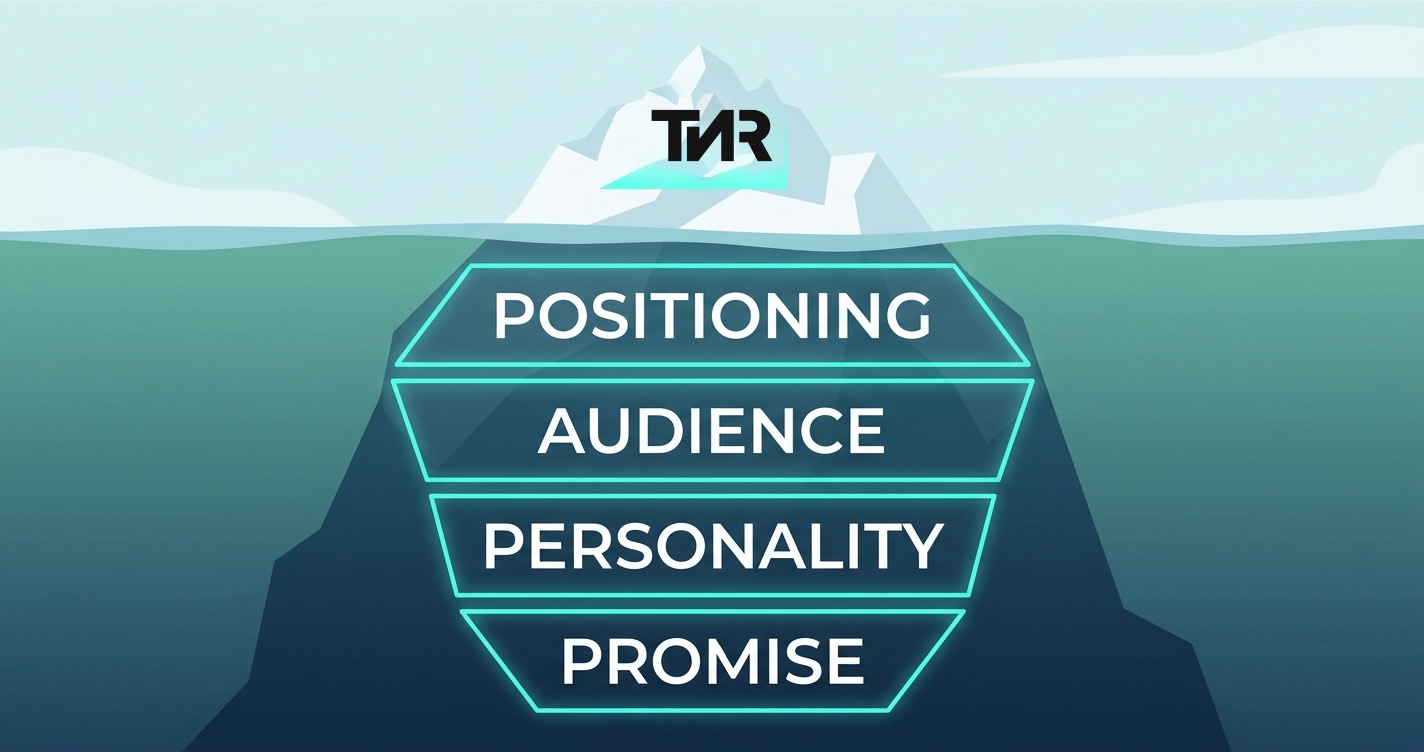
Brand strategy is the deliberate plan for how your business wants to be perceived, who it is for, and why it deserves to be chosen — and it exists before a single logo, colour, or word of copy is created. If brand identity is what people see, brand strategy is the reasoning that decides what they should see and why. Get the strategy right and every design decision afterwards has a clear answer to “does this serve the goal?” Get it wrong, and you end up with a beautiful brand that means nothing.
Most founders skip this step. They jump straight to a logo because a logo feels tangible and a strategy feels abstract. Then six months later the brand feels inconsistent, the website doesn’t convert, and nobody on the team can explain what the company actually stands for. That’s not a design problem. It’s a strategy problem wearing a design costume.
This guide breaks down what brand strategy is, the parts that make it up, and a practical way to build one — whether you’re launching, scaling, or quietly aware that your brand has drifted from what your business has become.
What brand strategy actually is (and isn’t)
A useful definition: brand strategy is the set of choices that define your brand’s purpose, positioning, audience, personality, and promise — the decisions that everything visible flows from.
It is not your logo. It is not your colour palette. It is not your tagline. Those are expressions of strategy. The strategy is the layer underneath that makes those expressions coherent. Think of an iceberg: the identity is the part above the water that everyone sees, but it’s held up by a much larger mass below — the thinking that gives it stability.
Here’s the practical test. If two designers were briefed on your brand and produced wildly different work that both felt “right,” you don’t have a strategy yet — you have taste. A real strategy narrows the field of acceptable answers, so the work becomes defensible rather than subjective.
Why strategy comes before design
Design without strategy is decoration. It can be lovely, but it can’t be measured, defended, or scaled. Strategy first changes three things:
- It makes decisions faster. When you know your positioning and personality, you stop debating whether the brand should feel “playful or premium” on every project. The strategy already answered it.
- It makes the work consistent. A team of people across a website, a pitch deck, social posts, and packaging can all stay on-brand because they’re working from the same source of truth.
- It connects design to business outcomes. Strategy ties each choice to a goal — more trust, a higher price point, a specific audience — so the brand becomes an asset rather than an expense.
This is the difference between a brand that looks good and a brand that works. The second one was planned.
The core components of a brand strategy
A complete brand strategy doesn’t need to be a 60-page document. It needs to make a clear, confident set of decisions across these areas.
1. Purpose and vision
Why does the business exist beyond making money, and where is it going? Purpose isn’t a charity statement — it’s the reason your team and your customers should care. A clear purpose gives the brand something to be about, which is increasingly what audiences reward. Vague purpose produces vague brands.
2. Positioning
Positioning is the single most important strategic decision: the specific space you want to own in your customer’s mind, relative to the alternatives. Good positioning is sharp enough to repel the wrong customers. “Affordable design for everyone” positions nothing. “The branding partner for fintech startups raising their next round” positions clearly — it tells a specific person they’re in the right place.
3. Audience
Not “everyone.” A strategy names the people you’re for, what they want, what they fear, and what they’re currently using instead of you. The more precisely you understand them, the more your brand can speak directly to them rather than broadcasting at a crowd.
4. Personality and voice
If your brand were a person, how would it behave? Confident or warm? Plain-spoken or expressive? Personality determines tone of voice, the feel of the visuals, and how the brand shows up in a comment section. It’s what makes a brand recognisable even before you see the logo.
5. Brand promise and values
What can a customer reliably expect from you, every time? The promise is the thing you must never break, because trust is built on consistency. Values are the few principles that guide behaviour when there’s no rule to follow.
6. Messaging pillars
The two to four core ideas you’ll communicate repeatedly. Messaging pillars keep your communication focused so you’re not reinventing what to say on every channel. They become the backbone of your website copy, your social content, and your sales conversations.
How to build a brand strategy: a practical process
You don’t need to disappear for three months. A focused strategy can be built in a few structured stages.
- Interview the people who know. Talk to founders, your best customers, and your team. Founders reveal intent; customers reveal reality. The gap between the two is often where your strategy lives.
- Audit what exists. Look honestly at your current brand, your competitors, and the category. What’s everyone else saying? Where is there white space nobody is claiming?
- Find the tension. The strongest brands resolve a tension — between what customers want and what the market currently offers. Name it.
- Make the decisions. Write down your positioning, audience, personality, promise, and messaging pillars as clear statements, not maybes. Strategy is a series of commitments.
- Pressure-test it. Would this strategy still make sense if a competitor copied your visuals? If yes, your strategy is doing the work. If your whole brand collapses without the logo, the strategy is too thin.
- Document it simply. A single, usable brand strategy document beats a beautiful deck nobody opens. It should be short enough that your team actually references it.
Brand strategy vs brand identity: the relationship
These two terms get used interchangeably, and that confusion costs businesses real money. Here’s the clean distinction:
- Brand strategy is the decision-making layer — purpose, positioning, audience, personality, promise.
- Brand identity is the expression layer — logo, colour, typography, imagery, and the brand guidelines that keep it consistent.
Strategy informs identity. Identity proves strategy. You can’t have a strong identity without a strategy underneath it — you’ll just have attractive assets with no shared logic. And a strategy with no identity stays trapped in a document, never reaching the customer. You need both, in that order.
Signs your brand strategy is missing or broken
- Your team can’t describe the brand the same way twice.
- Every design decision turns into a subjective debate.
- Your messaging changes depending on who wrote it that day.
- You’re competing on price because nothing else sets you apart.
- The brand looks fine but feels generic — interchangeable with five competitors.
If two or more of these sound familiar, the fix isn’t a new logo. It’s the strategy the logo should have been built on.
Frequently asked questions
What is brand strategy in simple terms? Brand strategy is the plan for how you want your business to be perceived and why customers should choose you. It defines your purpose, audience, positioning, personality, and promise — the decisions that all your visible branding is built from.
What’s the difference between brand strategy and brand identity? Brand strategy is the thinking — positioning, audience, personality. Brand identity is the visible expression of that thinking — logo, colour, typography, and guidelines. Strategy comes first and shapes identity.
Do small businesses and startups need a brand strategy? Yes — arguably more than large companies. A startup has less margin for inconsistency and a louder need to stand out. A clear strategy lets a small team punch well above its weight and make confident, fast decisions.
How long does it take to build a brand strategy? A focused strategy can be built in two to four weeks for most businesses, depending on access to stakeholders and how much existing research is available. The goal is clarity, not length.
Strategy is the part you can’t see — and the part that makes everything else work
The brands you admire didn’t get there by accident. Underneath the memorable logo and the website that converts is a set of deliberate decisions about who they’re for and what they stand for. That’s the strategy. It’s quieter than design, harder to show off, and far more important.
If your brand looks fine but isn’t pulling its weight, start with the layer beneath the surface.
Your brand deserves a strategy before it gets a logo. If you’re ready to build one that’s clear, defensible, and built to grow, explore our brand identity design service or start a conversation with the team.
Tagged with :